When specifying surge arresters for distribution networks, engineers and procurement specialists should look for these key attributes that distinguish a quality arrester built for decades of service:
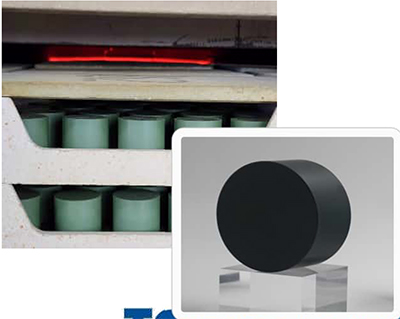
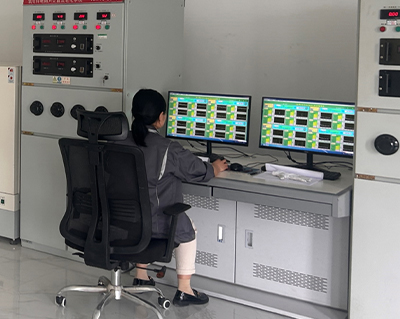
The MOV blocks are the arrester's most critical component. High-quality MOVs exhibit stable electrical characteristics over time: low aging rates ensure that leakage current and residual voltage remain virtually unchanged after years of continuous operating voltage and numerous surge events. Good MOV formulation guarantees the blocks withstand surges without degradation, cracking, or risk of thermal runaway. IEC and IEEE standards require a 1000-hour accelerated aging test at elevated temperature to verify MOV stability, along with repetitive charge transfer and thermal stability verification. High-quality arresters pass these tests with ample margin.
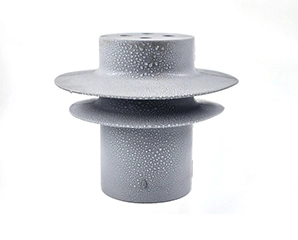
Controlled sintering process of MOVs |
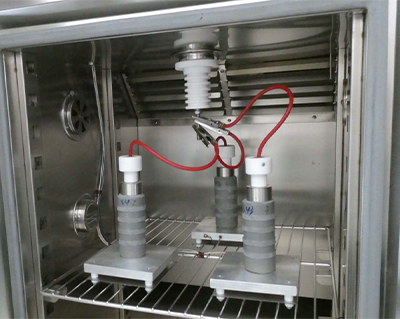
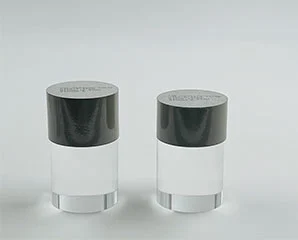
R&D lab: accelerated ageing tests on MOV batches |
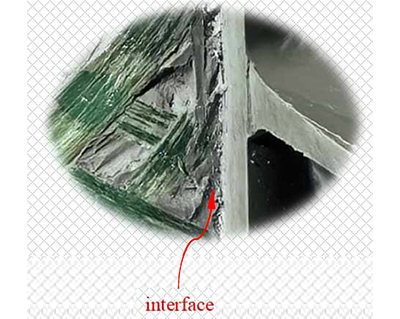
To achieve decades-long service life, an arrester must be impervious to moisture ingress. Modern distribution arresters favor polymer housings (e.g., silicone rubber HTV) directly molded or chemically bonded to the internal core, forming a one-piece weather shed with no gaps. The entire assembly is immersible, preventing moisture or contaminants from entering. A seamless moisture barrier eliminates internal partial discharge activity and keeps internal insulation dry throughout the arrester's life.
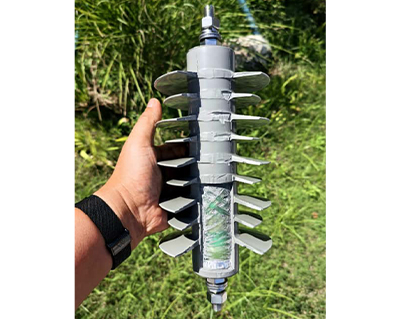
Manufacturers subject arresters to stringent verification: thermo-mechanical cycling and water immersion tests. Top-quality products are also tested (beyond standards) during production as sample tests to ensure adequate adherence between core and silicone housing. The result is a robust housing system known for hydrophobicity and UV stability that resists aging, cracking, and water ingress — directly addressing the prime failure mode.
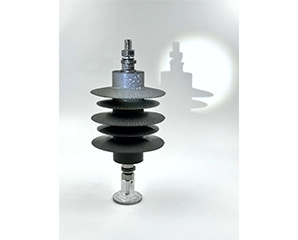
Adherence verification during production |
Bonding interface: arrester core to silicone housing |
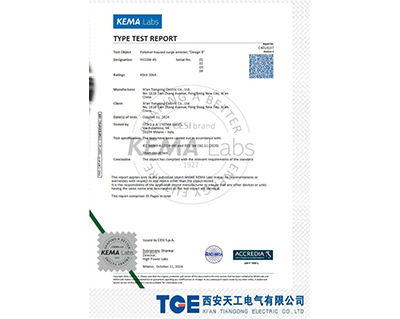
A trustworthy arrester at minimum meets all IEC 60099-4 or IEEE C62.11 type test requirements — and the best exceed them. Buyers should verify type test certificates from independent, accredited laboratories, and confirm that components and materials used for type tests are identical to those in production. Quality manufacturers perform additional design verification beyond the standards — testing under more extreme conditions or longer durations — to validate safety margins. Detailed datasheets, published guaranteed performance values, and a robust internal quality system ensure each production batch matches the tested prototype.
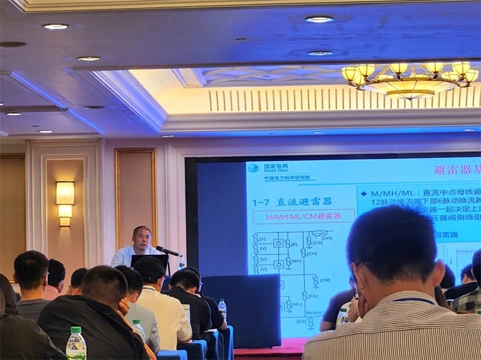
Short-circuit type test reports from independent accredited lab |
Accelerated ageing test on prorated arrester sections |
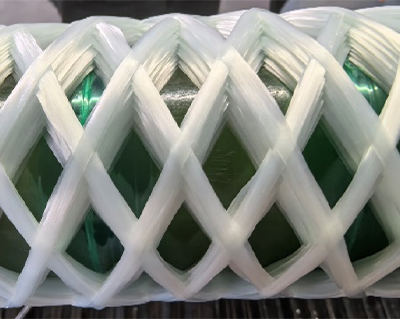
Distribution-class arresters face continuous outdoor stresses: cantilever loads, wind, vibration, and mechanical impacts. While many arresters rely on fiberglass-reinforced cores or wraps, TGE employs an advanced glass-fiber reinforced winding filament structure. This design delivers high mechanical strength and excellent short-circuit withstand capability, while reducing weight and minimizing manufacturing-induced defects — resulting in a mechanically stable core with improved thermal dissipation and enhanced safety margins.
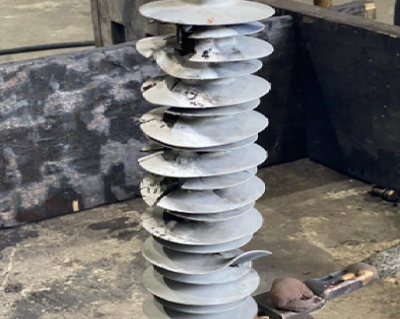
High-quality arresters also feature a controlled failure mode: in the event of an overload or internal fault, the arrester fails safely without violent rupture, limiting risk to surrounding equipment and personnel. The integrated disconnector isolates the failed unit from the system, preventing a permanent fault on the feeder. Compliance with IEC and IEEE short-circuit tests confirms the effectiveness of these safety mechanisms.
State-of-the-art glass-fiber reinforced winding filament structure |
Arrester samples after 20 kA short-circuit test (0.2 s) |
In summary, a well-built arrester combines electrical excellence (MOV quality, energy capability) with mechanical integrity (weatherproof construction and safe failure mechanisms). Once installed, a high-quality arrester provides decades of reliable, maintenance-free protection — quietly safeguarding the system throughout its entire service life.
 English